
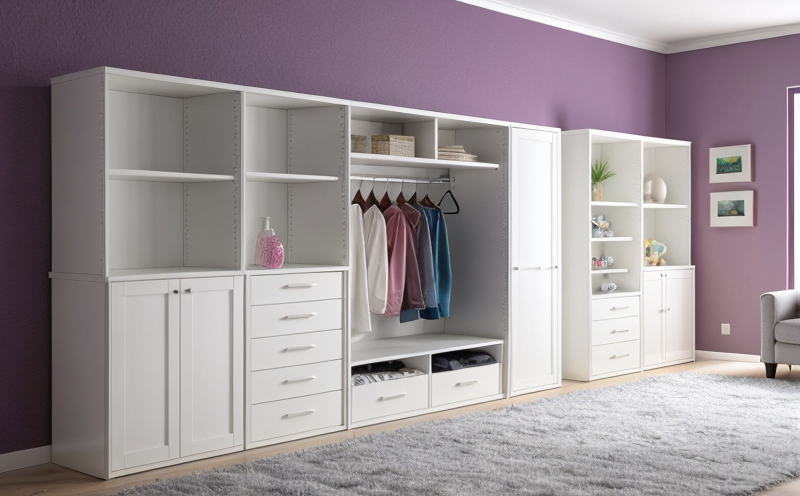
CSA O121 Plywood Materials Used in Storage Furniture Testing
The Canadian Standards Association (CSA) Standard O121 specifically addresses the materials used in storage furniture, ensuring they meet safety and durability requirements. This standard is crucial for manufacturers of cabinets, wardrobes, and other storage solutions designed to support heavy loads or house valuable items like electronics. The focus on plywood materials underscores the importance of structural integrity and resistance to deformation under load.
Plywood is a composite material made from thin layers (plies) of wood veneer that are glued together with adjacent layers having their grain at right angles to one another. In storage furniture, plywood serves as the core structure for cabinets, shelves, and drawers. Its strength comes from its layered construction, which distributes stress evenly across the board.
The testing outlined in CSA O121 aims to ensure that the plywood used meets specific performance criteria. These tests include:
- Flexural Strength
- Bending Stiffness
- Edge Compression Strength
- Shear Resistance
These parameters are critical for storage furniture because they determine how well the plywood can withstand the weight and pressure it will encounter during normal use. Flexural strength, for example, measures a material's ability to resist bending without breaking. Bending stiffness is related to its resistance to deformation under load.
Plywood used in storage furniture must also pass environmental conditioning tests to ensure it maintains its performance characteristics over time. This includes exposure to temperature and humidity changes, which can affect the plywood’s stability and integrity.
The testing process involves cutting specimen pieces from the plywood according to specified dimensions and then subjecting them to various mechanical loads and conditions. The results are compared against the standards set forth in CSA O121 to ensure compliance. Compliance is essential for manufacturers who want to maintain a reputation for quality and safety, as well as meet regulatory requirements.
Understanding the specific parameters tested under CSA O121 helps stakeholders, including R&D engineers, quality managers, and procurement officers, make informed decisions about material selection. This knowledge ensures that storage furniture is not only structurally sound but also durable enough to withstand typical environmental conditions and usage patterns.
Why It Matters
The importance of plywood compliance with CSA O121 cannot be overstated, especially in the context of storage furniture. Non-compliance can lead to product recalls, legal issues, and damage to a company’s reputation. Ensuring that materials meet these standards is critical for maintaining trust with consumers and regulatory bodies.
From a manufacturing perspective, compliance with CSA O121 ensures that products are consistently high quality and reliable. This consistency is vital in a competitive market where brand integrity and product performance are key differentiators. For procurement officers, choosing suppliers who adhere to these standards helps ensure that the materials they receive meet rigorous safety and durability criteria.
Compliance also plays a role in insurance policies for furniture manufacturers. Many insurance providers require proof of compliance with relevant standards like CSA O121 as part of their underwriting process. This requirement not only protects the manufacturer but can also offer peace of mind to consumers who know they are purchasing products that meet safety and durability benchmarks.
In summary, adherence to CSA O121 is essential for manufacturers of storage furniture. It ensures product quality, enhances brand reputation, and helps meet regulatory requirements, thereby protecting both the business and its customers.
Applied Standards
The application of CSA O121 involves a series of tests designed to evaluate plywood used in storage furniture for strength, durability, and resistance to environmental factors. These tests are critical in ensuring that the materials meet the safety and performance criteria specified by the standard.
Flexural Strength Testing: This test measures how much load the plywood can withstand before it bends permanently or breaks. It involves placing a sample of plywood under a gradually increasing load until it fails. The flexural strength is then calculated based on the maximum load applied before failure.
Bending Stiffness Testing: Similar to flexural strength, this test evaluates how resistant the plywood is to bending deformation when subjected to a specific load. It provides insight into the material's ability to maintain its shape under stress.
Edge Compression Strength Testing: This test assesses the plywood’s resistance to compressive forces applied along its edges. It helps determine whether the plywood can withstand the pressure exerted by heavy objects placed on it.
Shear Resistance Testing: Shear strength is evaluated by applying a force that tries to split the plywood sample laterally. This test provides information about how well the plywood resists splitting or delamination under shear stress.
Environmental Conditioning Tests: Before undergoing mechanical tests, plywood samples are conditioned in controlled environments to simulate real-world conditions such as temperature and humidity fluctuations. This conditioning helps ensure that the results of subsequent mechanical tests accurately reflect the material's true performance characteristics.
These tests must be conducted by qualified personnel using appropriate equipment according to established protocols. The results are then compared against the standards set forth in CSA O121 to determine compliance.
Eurolab Advantages
EuroLab is committed to providing comprehensive testing solutions that meet the highest international standards, including those outlined in CSA O121. Our advantages lie in our state-of-the-art facilities and experienced technical staff who specialize in furniture and materials testing.
We offer a range of services tailored specifically to the needs of manufacturers of storage furniture. Our expertise ensures that we can provide accurate and reliable results for all aspects of plywood compliance with CSA O121, from specimen preparation to final analysis and reporting.
Our advanced instrumentation allows us to conduct precise and repeatable tests, ensuring consistent results across multiple samples. This precision is particularly important in the context of storage furniture testing, where even small variations can impact overall product quality.
EuroLab’s commitment to excellence extends beyond just providing test reports. We also offer valuable insights into how manufacturers can improve their products based on our findings. Our technical support team works closely with clients to ensure they understand the implications of our test results and can implement necessary changes if required.
By partnering with EuroLab, manufacturers gain access to a network of industry experts who can provide guidance on material selection, design considerations, and quality assurance practices. This holistic approach ensures that clients not only meet but exceed the requirements set forth in CSA O121.